- Acid etching only cleans the top surface and cannot profile hard-troweled concrete or concrete sealed with curing agents commonly poured in RGV subdivisions.
- Mechanical diamond grinding opens the concrete capillaries to an International Concrete Repair Institute (ICRI) CSP-2 or CSP-3 profile, creating microscopic teeth for the resin.
- South Texas high water tables in Cameron and Hidalgo counties require a calcium chloride or moisture meter test before coating to prevent vapor drive blistering.
- Cracks and pitting must be chased with diamond v-groove blades and patched with high-tensile epoxy-urethane menders, never standard concrete caulking.
1. The Big Question: Can You Skip Grinding and Just Use Acid Etch?
Why 80% of DIY coating failures are directly traced to acid etching shortcuts
One of the top questions we hear from Harlingen and McAllen homeowners is: 'Do I really have to grind my garage floor before applying epoxy, or can I just use the acid wash packet that came in the box?' The short answer is: If you want your floor to last more than 18 months, diamond grinding is non-negotiable.
Muriatic acid or citric acid etching relies on a chemical reaction between the acid and free calcium hydroxide in the concrete paste. However, modern home builders in Harlingen developments use machine-troweled concrete to achieve super-smooth, dense slabs. Power troweling compacts the surface into a glassy, slick finish called the laitance layer.
Mild acid solutions simply cannot penetrate this dense, closed layer. Even worse, many Texas builders spray chemical curing compounds or clear water-sealers on fresh slabs during home construction to keep moisture in. Acid cannot break through these sealers—the acid wash merely pools on top, foams weakly, and leaves 70% of the pores completely sealed.
The Water Drop Test for Harlingen Homeowners
Pour a few tablespoons of water onto your bare garage floor. If the water beads up into droplets or takes more than 60 seconds to soak in and darken the concrete, your slab has a sealer or a tight power-trowel finish. Acid will completely fail on this slab. Only diamond grinding can open the pores.
2. Why Mechanical Diamond Grinding Is the Gold Standard
Understanding the CSP (Concrete Surface Profile) rating
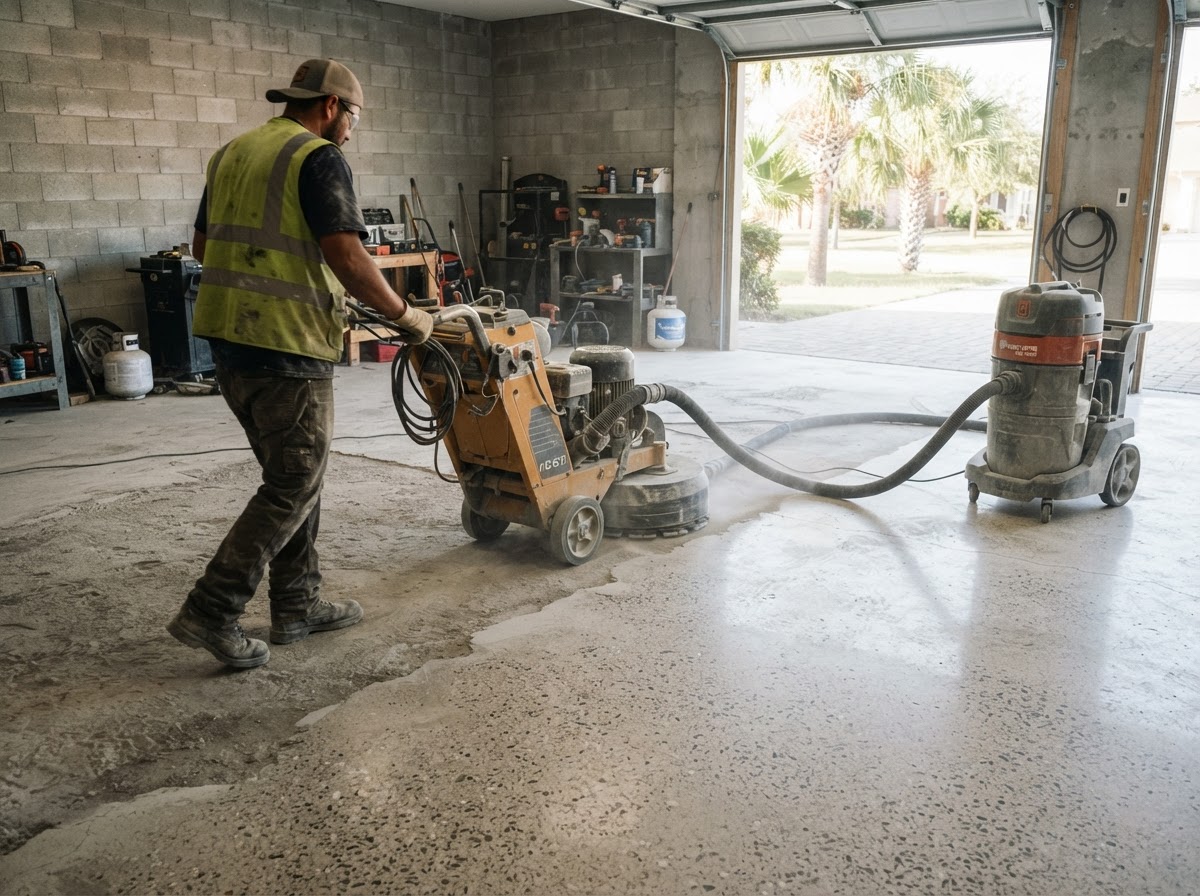
Professional coating contractors use heavy planetary diamond grinders equipped with industrial synthetic diamond segments (16-grit to 30-grit diamonds). These heavy machines spin in counter-rotating planetary motions, exerting hundreds of pounds of downward pressure.
This mechanical process removes the weak top cream (laitance), strips away previous oils, tire marks, and curing compounds, and profiles the concrete to a CSP-2 or CSP-3 profile—roughly the texture of 80-grit or 60-grit sandpaper.
When 100% solids epoxy primer is poured onto a diamond-ground slab, the resin behaves like liquid roots, soaking deep into the microscopic pores of the stone aggregate and concrete matrix. Once cured, it is virtually impossible to pull the coating off without physically fracturing the underlying concrete slab itself.
| Prep Factor | Muriatic / DIY Acid Etching | Industrial Diamond Grinding |
|---|---|---|
| Surface Porosity | Inconsistent; misses hard-troweled areas | 100% uniform CSP-2 to CSP-3 profile across whole floor |
| Sealer / Curing Agent Removal | Cannot remove sealers or siloxanes | Completely grinds away all sealers, paint, and wax |
| Oil & Grease Contaminant Removal | Acid floats on top of oil spots | Grinds deep past contaminated surface layers |
| Moisture Introduced into Slab | Adds gallons of water that takes 3–5 days to dry | Completely dry process hooked to HEPA dust extractors |
| Chemical Hazards & Fumes | Corrosive acid fumes rust metal tools and water heaters | Zero hazardous chemicals; clean mechanical cutting |
3. How to Fix Cracks, Pitting, and Spalling Before Epoxy
Never use silicone caulk or standard premixed vinyl concrete patch
Concrete shifts over time. In the Rio Grande Valley, expansive black clay subsoils expand when soaked during tropical thunderstorms and contract during dry, 100-degree summer droughts. As a result, almost every garage slab in Harlingen, Donna, or Weslaco has settling hairline cracks or spalling.
A major mistake amateur installers make is filling these cracks with elastomeric silicone caulk, latex grout, or hardware store hydraulic cement. Epoxy coatings cannot bond to silicone, and hydraulic cement shrinks as it dries, popping right back out under tire weight.
At Extreme Wash Pros, we use diamond-blade crack-chasing angle grinders to v-groove every fracture. We vacuum out the pulverized dust and inject two-part rapid-curing polyurea or epoxy-urethane menders. These industrial repair compounds cure harder than the original concrete within 30 minutes, bond at over 4,000 PSI, and are ground flush with the slab surface before the base coat is applied. Once coated, cracks are invisible and permanently stabilized.
4. The Critical Concrete Moisture Test for Harlingen Homes
Preventing osmotic blistering caused by South Texas groundwater
Harlingen sits in Cameron County with elevation close to sea level and relatively shallow groundwater tables. If a home was built without an intact 10-mil poly vapor barrier beneath the concrete slab, moisture vapor naturally migrates upwards through the slab through capillary action—a phenomenon known as 'moisture vapor drive.'
If you apply an impermeable coating over a slab with high moisture emission, water vapor becomes trapped. Over time, hydrostatic pressure forces the moisture against the underside of the epoxy, creating dime-to-quarter-sized bubbles that pop and peel away from the floor (osmotic blistering).
Before coating, Extreme Wash Pros performs moisture testing using digital impedance meters or ASTM F1869 anhydrous calcium chloride tests. If readings exceed 3 to 4 lbs per 1,000 sq ft / 24 hrs, we apply a specialized moisture-vapor barrier epoxy primer formulated to resist up to 15 to 20 lbs of hydrostatic pressure, ensuring your floor will never bubble or detach.
Frequently Asked Questions: Harlingen, TX
Can I rent a diamond grinder from a hardware store and do it myself?
You can rent small single-disc floor maintainers, but they are lightweight (typically 80–120 lbs) and often lack the downward torque to profile dense slabs. Additionally, without a commercial HEPA dust extractor, the process creates an overwhelming cloud of dangerous crystalline silica dust throughout your garage and home.
How long must fresh concrete cure before it can be epoxied?
New concrete must cure for a minimum of 28 to 30 days before diamond grinding and coating. Coating green concrete traps moisture and excess alkalis, causing immediate bond failure.
How can I tell if my garage concrete has a sealer on it?
Perform the simple splash test: splash a cup of clean water on several sections of the floor. If the water beads up like water on a freshly waxed car, a chemical sealer or curing compound is present and must be diamond ground away.
Extreme Wash Pros is a locally owned surface restoration and garage floor coating company based in Harlingen, Texas. Serving Cameron, Hidalgo, and Willacy counties with commercial planetary diamond grinding, 100% solids epoxy, and industrial polyaspartic systems.
Ready for a Showroom-Quality Garage Floor in Harlingen?
Get an accurate, transparent quote for your garage. We inspect your concrete slab, perform moisture checks, and provide free physical flake samples.