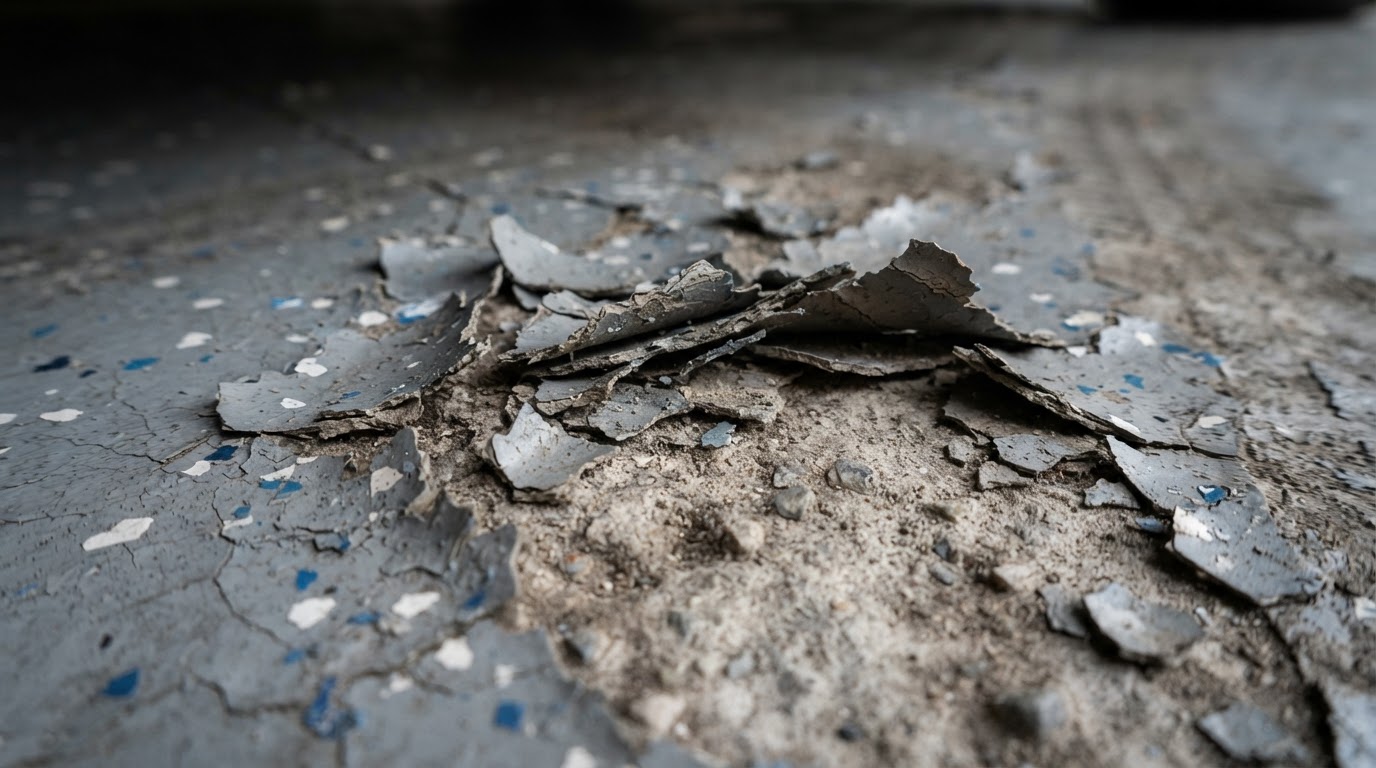
- 'Hot tire pickup' occurs when high-performance vehicle tires reach 140°F+, soften weak water-based resin, and pull it away from poorly profiled concrete as the rubber cools and contracts.
- Water-based DIY epoxies are 40% to 50% water; when the water evaporates, they leave behind a brittle film only 2 to 3 mils thick—hardly thicker than standard house paint.
- Professional 100% solids industrial epoxy does not evaporate—every ounce poured cures into an ultra-tough, 10 to 12 mil thick structural polymer layer.
- Polyaspartic and polyurea coatings offer 4x the abrasion resistance of epoxy, 100% UV stability (no yellowing from garage door sunlight), and fast cure times.
1. The Physics of 'Hot Tire Pickup' in South Texas
Why hot asphalt, sticky tire compounds, and weak paints collide
If you ask ten homeowners in Harlingen who attempted DIY garage floor painting why they regretted it, nine will mention the same symptom: two clean rectangular patches where their car's front tires sit, showing bare, stripped concrete.
In automotive engineering, modern radial tires contain synthetic rubber polymers, plasticizers, and carbon black compounds designed to maximize road grip. When you drive down I-69E or US-83 on a sunny South Texas day with ambient temperatures above 95°F, your tires heat up to 135°F–160°F. When you park inside your shaded garage, the hot tires rest directly against the floor.
As the vehicle sits, the high heat transfers from the tire tread into the coating, softening weak water-based resin. Concurrently, as the rubber cools down overnight, it microscopically contracts and grips the softened floor like a suction clamp. The next morning, when you back your vehicle out, the mechanical grip of the tire easily overcomes the weak bond of the paint, tearing it clean off the concrete. This is 'hot tire pickup.'
The 300°F Thermal Threshold of Polyaspartic Coatings
Unlike DIY acrylics that soften at 115°F, Extreme Wash Pros' industrial 100% solids epoxy base and polyaspartic clear topcoat are thermally stable past 300°F. Your tires can be scorching hot off the highway, but the coating will never soften, grab, or delaminate.
2. Water-Based Epoxy vs. 100% Solids Epoxy: The Critical Difference
Where did your product go after it dried?
Many people assume all products labeled 'epoxy' are the same. That could not be further from the truth. Big-box store kits are almost exclusively water-based or solvent-thinned epoxies containing only 40% to 50% solids by volume. The remaining 50% to 60% of the can is plain water or solvent carrier.
When you roll a water-based kit onto your floor at a wet film thickness of 6 mils, the water evaporates into the air during the curing process. What remains on your concrete is a dry film thickness (DFT) of only 2.5 to 3 mils—roughly the thickness of a single sheet of copy paper. That paper-thin film cannot withstand heavy tools, dropped jacks, or hot tires.
In stark contrast, Extreme Wash Pros installs commercial 100% solids cycloaliphatic epoxy. The term '100% solids' means there is zero water, zero solvent, and zero filler to evaporate. What we roll onto your floor stays on your floor. A 10 mil application cures to a full 10 mils of dense, rock-hard polymer that bridges imperfections and forms an impenetrable chemical barrier.
| Attribute | Water-Based DIY Epoxy | 100% Solids Pro Epoxy Base | Aliphatic Polyaspartic Topcoat |
|---|---|---|---|
| Solids by Volume | 40% – 50% (50% evaporates) | 100% (Zero evaporation) | 85% – 100% high-solids |
| Dry Film Thickness | 2.5 to 3 mils (very thin) | 10 to 16 mils (heavy-duty) | 6 to 8 mils protective armor |
| Tensile Strength | 1,500 – 2,500 PSI | 8,500 – 10,000+ PSI | 9,000 – 12,000 PSI |
| UV Stability (Sunlight) | Yellows / ambers quickly | Moderate (can yellow over years) | 100% UV-stable; never yellows |
| Chemical Resistance | Stains easily with motor oil/gas | Immune to oil, fluids, battery acid | Exceptional chemical & acid defense |
| Taber Abrasion Resistance | Poor (easily scratched by grit) | Good | 4x tougher than standard epoxy |
3. Is Polyaspartic or Polyurea Better Than Epoxy for a Garage?
Why hybrid multi-layer systems outperform single-product hype
You may have seen aggressive advertising from national franchise companies claiming: 'Epoxy is obsolete, only buy 1-day polyurea!' Is polyaspartic really better than epoxy?
Here is the honest truth from real coating professionals: Polyaspartics are fantastic topcoats, but they cure extremely fast (often in 20 to 30 minutes). When applied directly to bare concrete as a primer, polyaspartic frequently does not have enough time to sink deep into the concrete's capillaries before it hardens, which can lead to edge peeling on high-density slabs.
The ultimate, bulletproof system—and the one we install throughout Harlingen—is a hybrid multi-layer system: We use a slow-curing 100% solids epoxy primer that deeply penetrates and anchors into the diamond-profiled concrete slab. We then broadcast decorative color flakes to 100% rejection. Finally, we seal everything with an industrial polyaspartic clear coat. This gives you the unmatched deep-pore adhesion of epoxy combined with the scratch resistance, UV stability, and quick return-to-service of polyaspartic.
4. Do I Really Need a Clear Top Coat Over Epoxy?
Skipping the clear coat is like buying an expensive car without a clear finish
Another question we frequently receive is: 'Can I save money by not putting a clear top coat over my garage floor?'
If you apply a base coat and scatter decorative flake chips without a clear top coat, the flakes remain exposed. Dirt, motor oil, and spilled coffee will catch between the edges of the flake chips and become impossible to clean. Furthermore, bare epoxy without a UV-stable aliphatic polyaspartic top coat will slowly amber, yellow, and chalk when exposed to sunlight entering through an open garage door or garage windows.
A heavy polyaspartic clear coat encapsulates the flakes into a smooth, seamless glass-like layer that is 100% waterproof, easily mopped, and permanently resistant to UV degradation.
Frequently Asked Questions: Harlingen, TX
How do I fix a DIY epoxy floor that is currently peeling in Harlingen?
Unfortunately, you cannot simply paint over peeling epoxy. The failed coating must be mechanically ground off using a planetary diamond grinder to return the slab to bare concrete before applying a proper 100% solids system.
Will motor oil or transmission fluid stain a polyaspartic topcoat?
No. Professional polyaspartic and 100% solids epoxy topcoats are chemically non-porous. Motor oil, transmission fluid, brake cleaner, and antifreeze can sit on the floor for days and wipe away cleanly with a rag.
Does sunlight turning garage epoxy yellow happen in Texas?
Yes. Traditional epoxies are sensitive to ultraviolet (UV) radiation. Even inside a garage, sunlight striking the first 3 to 5 feet near the garage door will turn standard epoxy a dingy amber-yellow within 1 to 2 years unless protected by an aliphatic polyaspartic topcoat.
Extreme Wash Pros is a locally owned surface restoration and garage floor coating company based in Harlingen, Texas. Serving Cameron, Hidalgo, and Willacy counties with commercial planetary diamond grinding, 100% solids epoxy, and industrial polyaspartic systems.
Ready for a Showroom-Quality Garage Floor in Harlingen?
Get an accurate, transparent quote for your garage. We inspect your concrete slab, perform moisture checks, and provide free physical flake samples.